James Flannigan served as an air gunner with No. 76 Squadron, Royal Air Force Volunteer Reserve, flying the Handley Page H.P.57 Halifax I. He was the son of Edward A. and Agnes Flannigan, of Edinburgh. Before the war he worked in the postal service, before joining the Royal Air Force.
After James was killed, his parents emigrated to Australia. Both later died there. Agnes Flannigan worked at the Pioneer Museum in Armadale, Western Australia, and was said to know more local history than most who had lived there all their lives.
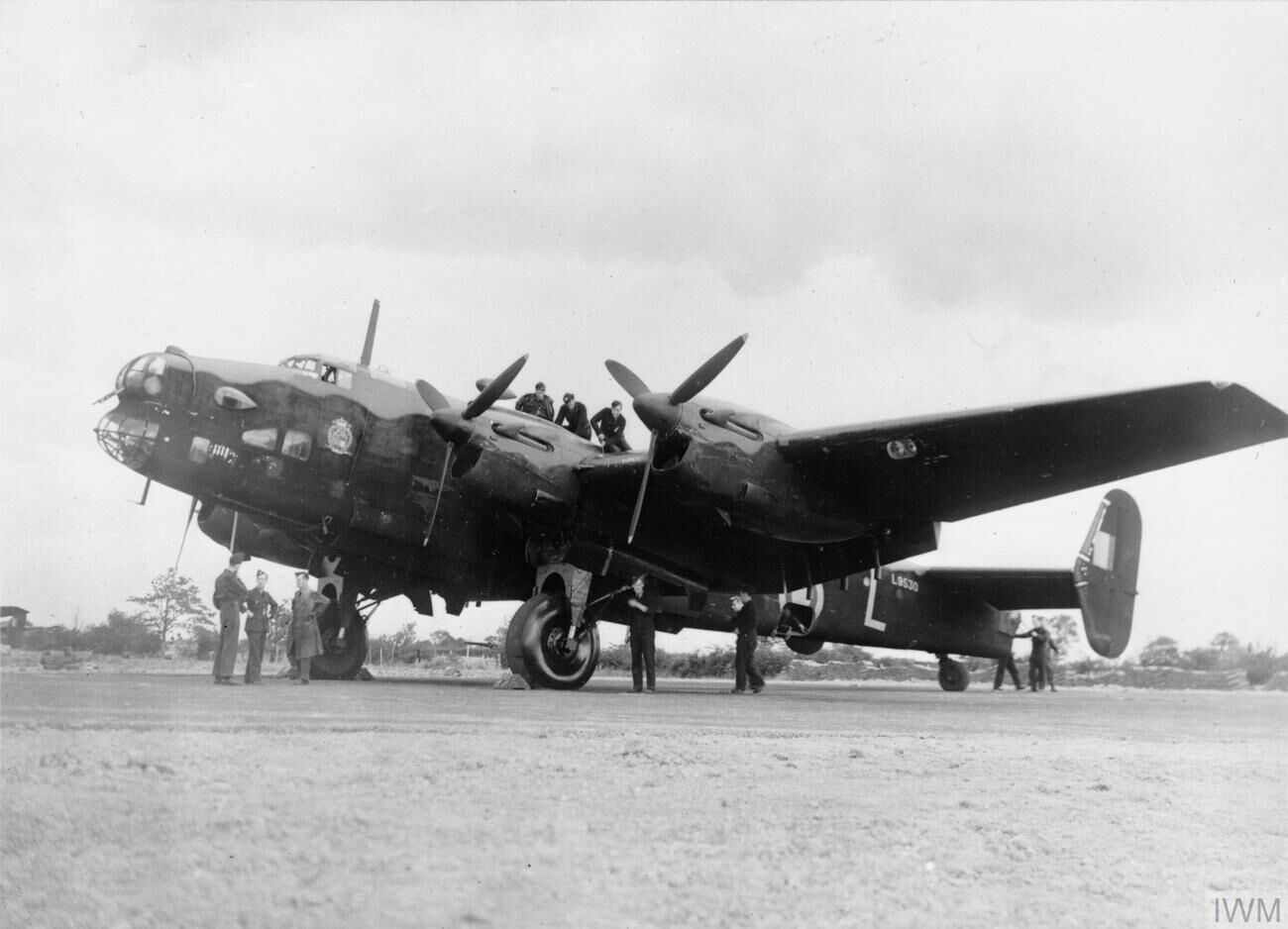
Handley Page Halifax Mark I Series 1, L9530 ‘MP-L’, of No. 76 Squadron RAF, undergoing maintenance at RAF Middleton St George, County Durham. James flew as air gunner in L9530 on 19 and 21 July 1941. The aircraft was shot down attacking Magdeburg on 15 August 1941, a little over two weeks before James survived a bale-out of his own returning from Frankfurt.Photo: Royal Air Force Bomber Command, 1939–1941 (IWM CH 3393)
Biographical detail from an oral history interview with William (Bill) Allan, who held James's flying log book in his private collection.
Night of 29/30 August 1941
A bale-out survived
Operation to Frankfurt
On the night of 29/30 August 1941, James's crew took off from Middleton St George at 21:13 hrs in Halifax L9518 for a bombing operation against Frankfurt. The target was bombed successfully. On the return flight, over the Finningley area, both starboard engines failed through fuel starvation, and as a third engine began to fail at around 2,000 feet, the pilot ordered the crew to bail out.
James Flannigan was among those who got out safely. The rear gunner, Sgt George William Duckmanton, delayed leaving the aircraft and was killed, too low for his parachute to deploy fully. The pilot, S/Ldr Richard Bickford DFC, was also killed, thought to have been struck by a windmilling propeller as he escaped through the aircraft's top hatch, his parachute then fouling the tail. The unmanned aircraft crashed near Pocklington, Yorkshire, at approximately 04:15 hrs.
S/Ldr Richard Bickford DFC (RAF) — Pilot — killed
P/O Philip Inigo-Jones (RAF) — Observer
Cpl Peter Davies Randall (RAF) — Flight Engineer
F/Sgt James Flannigan (RAFVR) — Air Gunner
Sgt John Medcalf Reilly (RAFVR) — Air Gunner
Sgt George William Duckmanton (RAFVR) — Rear Gunner — killed
Cpl Randall was flying operationally as flight engineer while still holding the rank of Corporal, unusual for aircrew at this stage of the war; he was killed on a later operation on 30 December 1941. P/O Inigo-Jones survived the war — his first wife later remarried Douglas Bader.
Night of 13/14 September 1941
A second bale-out survived
Operation to Brest
James's own log book records the entry plainly: “Ops. — Brest. Baled out at 03:35 hrs N. Bedford.” His crew took off from Middleton St George at 01:35 hrs on 14 September 1941 in Halifax L9567 for a bombing operation against the German warships at Brest. On the return flight the aircraft suffered engine failure, and the crew baled out north of Bedford at 03:35 hrs.
The pilot, P/O Ronald Edward Hutchin, did not get out with them. The aircraft continued on and came down in a wheels-up belly landing in a field near Water End, in the parish of Renhold, just east of Bedford, and Hutchin was killed. He was 23, the son of Ronald F. and Dorothy A. Hutchin of Burnham-on-Sea, Somerset, and is buried in Burnham-on-Sea Cemetery. One other crew member was injured, likely in the bale-out itself; James and the rest of the crew came through unhurt.
P/O Ronald Edward Hutchin (RAF) — Pilot — killed
Sgt A. Browne (RAF)
F/Sgt James Flannigan (RAFVR)
Sgt R. Littlehales (RAF)
Sgt Charles Edward Wood (RAF)
Sgt A. V. Wallace (RAF)
Individual in-aircraft roles for the surviving crew, and which of them was injured, have not yet been confirmed from available records; if further documentation comes to light, this page will be updated. Sgt Charles Edward Wood also flew with James on the Dunkirk operation on which he was lost the following month.
Night of 30/31 October 1941
Lost without trace
Operation to Dunkirk
On the night of 30/31 October 1941, L9602, with code MP-N, took off at approximately 19:17 from Middleton St George for a bombing operation over Dunkerque, France. The aircraft failed to return to base, and is believed to have crashed somewhere in the North Sea. It was lost without trace.
P/O Francis Conn Brooks (RCAF)
F/Sgt James Flannigan (RAFVR) — Air Gunner
Sgt John Rudolph Johnson (RCAF)
Sgt James Mycock (RAFVR)
Sgt Charles Edward Wood (RAF)
Individual in-aircraft roles for P/O Brooks, Sgt Johnson, Sgt Mycock, and Sgt Wood have not yet been confirmed from available records; if further documentation comes to light, this page will be updated.
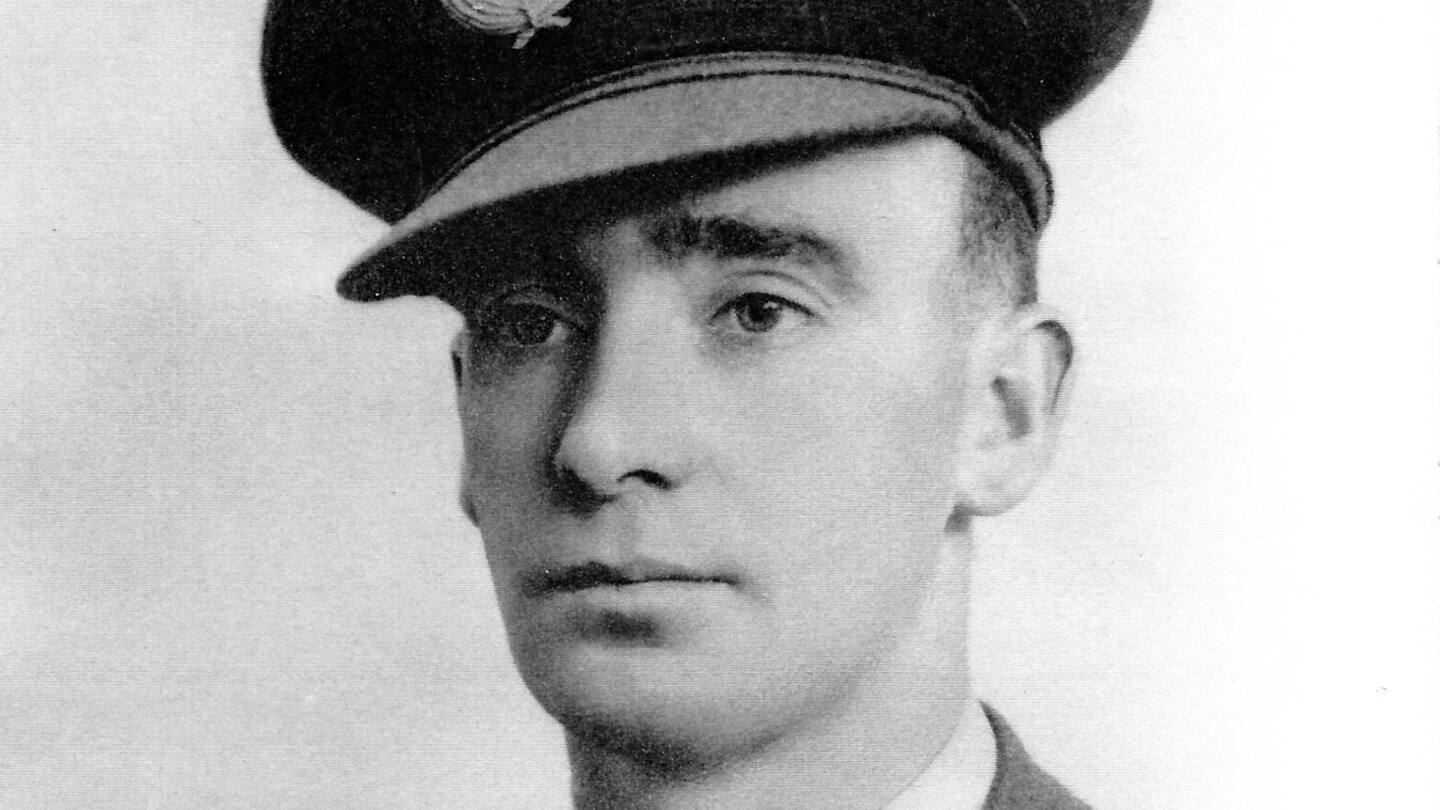
Pilot Officer Neil Frederick McLean, RNZAF, of Te Kawa, Auckland, New Zealand. He flew as 2nd Pilot in Halifax L9602 alongside James Flannigan on the Dunkirk operation of 30/31 October 1941, his fourth operational flight, on which he was lost.
Photo: family collection, via Neil Thorsen, “Cherished uncle namesake never knew,” NZ Herald
The crew have no known grave and are commemorated on the Runnymede Memorial, Surrey — O'Brien on Panel 60. A photograph and further record of pilot F/Sgt Charles Stuart O'Brien, RCAF, is held by the
Canadian Warplane Heritage Museum's CASPIR archive.
F/Sgt Charles Stuart O'Brien, RCAF (Service No. R/65254), was born 9 January 1918 in Moncton, New Brunswick, the son of Allen Roy O'Brien and Laviva (Patriquin) O'Brien, and brother of Robert, Eugene and Doris. Before the war he studied at Prince of Wales College and worked as a stenographer and furrier's cutter in Charlottetown, PEI, then enrolled as an arts student at Acadia University, Wolfville, NS, in 1938, where he was a Sergeant with the Officers' Training Corps and played basketball and tennis. He enlisted in the RCAF in July 1940, went overseas in April 1941, and served with 19 OTU, then 10 Squadron RAF, before joining 76 Squadron in October 1941 — just weeks before the Dunkirk operation on which he was lost, aged 23.
Source: Wartime Heritage Association2nd Pilot P/O Neil Frederick McLean, RNZAF, was born in 1915, the son of Charles Stewart and Mary Florence McLean of Te Kawa, Auckland, New Zealand, and husband of Emily May McLean of Mount Eden, Auckland. This was his fourth operational flight. Further record held by the
Canadian Warplane Heritage Museum's CASPIR archive.