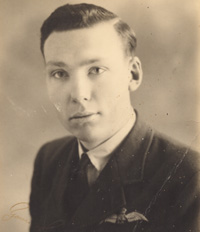
Allan Lodder was born in the family home of his maternal grandmother, Sarah
Morris, in Silkstone,
Queensland, on 24 May 1923, to parents Reginald and Gertrude Lodder.
In 1929 the family moved to Bundaberg, where Allan’s father had employment
with Wyper Brothers as manager of their joinery factory. The family moved
again, this time to Gladstone, in 1937. After working in the building and
joinery industry in Gladstone for some years, Allan’s father established
Enterprise Joinery Works in Herbert Street in 1946.
Allan began his working life at Gladstone Co-operative Dairy as a laboratory
technician, and continued to work there until he commenced training for
the Royal Australian Air Force at Sandgate.
Training
Allan commenced his aircrew training at 8 Initial Training School at Sandgate
in May 1942, on 28 Course, at 18 years of age. He then completed six months
of training at Kingaroy, studying electrical science, theory of flight, signals,
morse code (send and receive at 12 words per minute), aircraft recognition,
navigation, firearms drill and physical training. On completion of the course,
Allan was selected to proceed to pilot training — a great thrill, as everyone
wanted to be a pilot. From here, those selected travelled by train to Narrandera,
NSW, to No. 8 Elementary Flying School to train on DH82
Tiger Moths.
Because Allan’s group had arrived two weeks before flying training could
commence, they were transported by tender to a satellite landing field at Bundidgarie,
near Grong Grong,
each day to assist ground staff handling and refuelling aircraft, before being
driven back to the main drome each evening. On one such day, instructor Ken
Gregor and his pupil Colin Pickworth flew over the tender, climbed to 200 feet
and attempted a stall turn. Without enough height to recover, they crashed into
Allan’s tender, killing fellow course pupil Gerald Ryan.
Allan suffered bad lacerations and a dislocated left arm, and after a half-hour
wait for the ambulance was taken to Narrandera General Hospital, before being
transferred several days later to No.
1 RAAF Hospital at Forest Hill, Wagga Wagga. The wound became infected with
gas gangrene, requiring several operations, two blood transfusions and skin
grafts. After several months Allan was sent to a sheep station called “Wisconsin”
for two months’ convalescence, before doctors passed him fit to continue
training.
Having lost five months, Allan was now on 33 Course. His first flight was on
15 February 1943, and he flew solo for the first time on 1 March — a marvellous
feeling, climbing away over the hangars, singing as loud as he could. On completion
of 33 Course, Allan was posted to No. 8 Service Flying Training School at Bundaberg,
Queensland, flying twin-engined Ansons from 14 April, and met up with his old
mates from 28 Course, Joe Herman and Rex Breusch, who were nearing the end of
their own courses. Allan completed his last training flight on 28 July and was
proud to be presented with his pilot’s wings and promoted to Sergeant
Pilot.
After several weeks’ pre-embarkation leave, Allan was sent to Bradfield
Park, Sydney, for a short time, then boarded the American ship USS
Mount Vernon for San Francisco, travelling by train across the USA to Camp
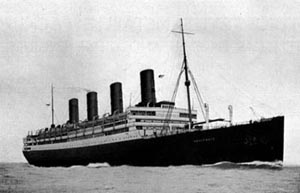
Miles Standish, near Boston. After several weeks he boarded the RMS
Aquitania at New York, bound for Greenock, Scotland, before travelling by
train to Brighton, the RAAF personnel and dispatch base in England. Allan then
spent about two months on further ground studies — navigation, aircraft
and ship identification, and machine gun, shotgun and pistol shooting.
RMS Aquitania
Allan’s next posting was to 18 EFTS at Fairoaks,
Chobham, flying Tiger Moths again to become used to map-reading over England
— certainly different to Australia. The crew were camped at Fairoaks,
driven each day by tender to Smith’s Lawn, Great Windsor Park, for flying.
At the end of December they returned to their base at the Grand Hotel, Brighton,
until Allan’s posting to No. 15 Advanced Flying Unit at Babdown Farm,
Tetbury, Gloucestershire, flying Airspeed Oxfords.
Early in June Allan was posted to No. 21 Operational Training Unit, B Flight,
on twin-engined Wellington bombers at Moreton-in-Marsh,
near Oxford. It was here he picked up his crew — navigator, wireless operator,
rear and mid-upper gunners, and bomb aimer. Most flying was done from the satellite
drome at Enstone. Their first experience of enemy attack came over Caen and
Bayeux, France, a few days after D-Day; they evaded a night fighter with evasive
corkscrews. On return to England their home drome was closed under fog, forcing
a diversion to Newmarket for several days.
On completion of the course, Allan’s next posting was to No. 1664 Heavy
Conversion Unit at Dishforth,
Yorkshire, flying Halifax Mk II and V four-engined bombers. Near the end of
the course, during a night bombing exercise, his port outer engine caught fire;
after emergency drills the fire was put out, and on the landing approach on
three engines the other port engine lost power. Coming in with plenty of height,
Allan managed to put the aircraft down safely. The CO called him to his office
the next day, promoted him to Pilot Officer from Flight Sergeant, and entered
a green endorsement in his log book for “meritorious” flying.
462 Squadron
Allan’s next posting was to 462 Squadron, 4 Group Bomber Command, stationed
at Driffield, Yorkshire,
with his first flight on 9 November — a check of the new drome with F/Lt
(“Fingers”) Finley. Allan’s crew consisted of:
Flew as second pilot with Flying Officer Rate, to gain experience, on a daylight
raid on Jülich.
A frightening experience in daylight, with so many aircraft dropping bombs
at the same time and heavy anti-aircraft fire over the target — you
can see too much of what is going on around you. F/O Rate was shot down several
months later.
Op 221
November 1944
Night attack on an oil refinery at Sterkrade, at 19,000 feet. Coned by a
searchlight over the target — a harrowing experience — but managed
to get clear and head for home. Unable to pick up Driffield with fuel running
low, diverted to the large emergency crash drome at Carnaby, crew standing
by the escape hatches with parachutes ready in case of running out of fuel.
Landed with only a few minutes’ fuel remaining.
Op 328
November 1944
Industrial target at Essen, flying at 20,000 feet, with only light flak.
Op 430
November 1944
Railway junctions, at 19,000 feet, with moderate flak; bombed on sky markers.
Op 52
December 1944Halifax ‘F’
Target was the Hagen railway
marshalling yard, flying at 14,000 feet; encountered ice in the clouds.
On 5 December, Allan went on seven days’ officer kitting-out leave
in London, and on 6 December married Eileen Mercer at Woking Methodist Church
— missing his train connection and arriving ten minutes late! The couple
spent their honeymoon week at the Hotel Windermere in the Lake District. Allan
had met Eileen earlier in 1943 at a dance at Chobham Community Hall.
Op 618
December 1944Halifax ‘G’
Target was Duisburg railway
and communication centres. Flew at 20,000 feet, 10/10 cloud, with moderate
icing.
Op 721
December 1944Halifax ‘G’
Target was Cologne railway
marshalling yards, at 18,000 feet, 10/10 cloud, sky markers, with moderate,
accurate flak — some close bursts but no damage.
On 29 December, Allan flew his aircraft “C for Charlie” down
to the squadron’s new base with 100 Group at Foulsham
in Norfolk.
Op 82
January 1945MZ-467 ‘C for Charlie’
First trip with 100 Group, in the Frankfurt area, carrying an extra crew
member for window manning.
Op 96
January 1945MZ-467 ‘C for Charlie’
Special operations, bomber support in the Cologne–Dortmund area, at
18,000 feet.
Op 1014
January 1945MZ-467 ‘C for Charlie’
Special operations, bomber support to Mannheim. Experienced heavy flak and
thick searchlights.
Op 1128
January 1945MZ-913 ‘J for Jane’
Special operations, bomber support; bombed Mainz at 20,000 feet, temperature
minus 42°F. Thick snow on the runway on return to Foulsham.
Op 121
February 1945MZ-467 ‘C for Charlie’
Special operations, bomber support over Mannheim, at 20,000 feet, temperature
minus 36°F, with moderate flak and searchlights. Hit by anti-aircraft
fire over the target on the starboard wing, holing fuel tank 4 and damaging
the starboard flaps, undercarriage, and bursting a tyre. On landing, the flat
tyre caused the aircraft to swing off the runway and become bogged.
Op 132
February 1945MZ-913 ‘J for Jane’
Flying at 20,000 feet over Mannheim, temperature minus 29°F. Light icing,
close flak, but no damage.
Op 148
February 1945
Flying at 20,000 feet over the Ruhr
area. Cloud to 21,000 feet, light icing, temperature minus 35°F.
Op 1510
February 1945MZ-467 ‘C for Charlie’
Special operations flying over the Ruhr area again, at 20,000 feet, temperature
minus 42°F. A very quiet and safe trip.
Op 1630
March 1945
Special operations over Stade, on the Elbe, Hamburg, flying at 20,000 feet,
temperature minus 35°F.
Op 172
April 1945MZ-467 ‘C for Charlie’
Special operations to Stade
aerodrome, Hamburg. Thick
searchlights; port outer motor feathered 50 miles off the English coast. Landed
back at base on three engines.
Op 1815
April 1945MZ-467 ‘C for Charlie’
Special operations to the Lechfeld–Munich area. Bombed the Lechfeld
aerodrome at 18,000 feet.
Op 1916/17
April 1945MZ-467 ‘C for Charlie’
The Augsburg Operation
Special operations to the Augsburg
area. Shot down by a German fighter from underneath, Allan went straight out
of control and the aircraft caught fire. The only crew member to escape by
his own efforts was Casterton, the rear gunner. Allan did not know what eventually
happened, but was certain the aircraft exploded and that he and Pete Naylor
must have been blown clear; the remainder of the crew were killed.
Allan regained consciousness falling through the cold, dark night, with the
target indicator flares above him. He felt for his chest parachute and found
it still intact; he must have pulled the ripcord, as he remembers the silk
cords pulling out of their pockets, then everything went red before he hit
the ground in a forest, saying a prayer of thanks at being alive. He could
hear other aircraft gradually fading away as they headed back to England.
Allan walked towards his burning aircraft, hoping to find other survivors,
without success, then set off hoping to walk south to Switzerland. He came
across a path leading to cart tracks and a small village, where the people
took him in, gave him clean cloth and oil for his burns, and eventually carried
him by horse and cart to Kloster Holzen, then being used as a German field
hospital, about 25 miles north of Augsburg.
The Harness Release Mystery
Allan Lodder’s own account, as published
in Brave and True (2nd edition), Stan Parker & John McManus
DFC
I was pilot of Halifax Mk X aircraft, C for Charlie, of 462 Squadron, Foulsham,
attached to 100 Group, engaged on a special duties operation to an aerodrome
about fifteen miles north of Augsburg, on 17th April 1945. When we turned
on our “fishpond” ten minutes before target, it was reported
faulty, so after dipping the wings to look below for signs of enemy aircraft,
I commenced my bombing run.
In the final stages of the bombing run we were hit by gunfire from below.
The control column jammed forward and, even though I tried with all my strength,
I could not move it. Luckily the aircraft was in a flat, steep dive. I tried
to call the crew on the intercom without success, and guessed the radio
set had been hit. I pressed the emergency bell several times, then my flight
engineer came through from amidships, ablaze all over, and collapsed down
the steps to the navigator’s compartment.
The enemy aircraft must have been following us down, as once again we were
hit from astern, tracers disappearing ahead of us. I took my navigator-type
chute from the locking lever on the throttle pedestal and clipped it on
without releasing my safety harness. The cockpit was engulfed in flames
as I struggled, attempting to undo the clip. I jettisoned my top hatch,
realising this would be my only hope of escape, and tried to break the harness
straps, hoping they had been burnt partly through. My oxygen mask caught
fire and, after taking off my helmet, I put my head partly out the side
window and tried to protect my face with my arm and hand.
I said what I thought were my last prayers, and prayed for the ground to
come and finish my agony. There was a strong sinking feeling, then I was
falling through the cool, dark night air. I felt for my chute and was relieved
to find it still intact. I do not remember pulling the chute cord, but recollect
the great feeling of the silk cords pulling out of each pocket. I realised
I must be close to the ground and, for some reason, started to count. I
reached five before hitting the ground, at 3:30am.
Note: Allan’s own account
in Brave and True and the version published in Pimpernel Squadron
(see The Crash of MZ-467) agree on the essential
sequence — the control column jamming, the flight engineer arriving
ablaze, and Allan clipping on his parachute without releasing his seat harness
— but neither source explains how the harness came free. Allan’s
own belief, recorded in his Op 19 log entry, was that the aircraft exploded
and that he and bomb aimer Pete Naylor were blown clear; this is presented
here as his own understanding rather than a confirmed cause. The target is
given in Brave and True as an aerodrome roughly fifteen miles north
of Augsburg, consistent with the Donauwörth fighter airfield named in
Pimpernel Squadron.
See also: The Crash of MZ-467
— the fuller narrative, as told by Allan and published in Pimpernel
Squadron, including the combat report filed by the German night fighter
crew.
Allan does not remember most of the detail for the first week, apart from
being well looked after by the nuns, doctors and other German soldiers. Early
in May the American advance overtook the area, and he was taken out by ambulance
through a field dressing station at Crailsheim.
From there he was flown back in a DC-3, with other wounded, to England, near
Swindon. The Red Cross
met the aircraft on arrival and sent telegrams home to Eileen — the
first news she had that Allan was alive.
From Swindon, Allan was taken by ambulance to hospital at Cosford, near Wolverhampton.
On 8 May the war in Europe ended; doctors reset his ankle and dressed his
burns, and the commanding surgeon gave him a whisky in celebration. A couple
of days later Eileen arrived at the hospital, and the couple booked a room
at a village inn; Eileen pushed Allan each day in his wheelchair back to hospital
for treatment. Once his left foot was out of plaster he graduated to crutches,
was granted a few weeks’ leave, and was then sent to physiotherapy at
Loughborough College
for several weeks.
On completion of this, Allan was sent to Mongewell
Park, a mansion on the banks of the Thames, for convalescence. Squadron
Leader Russell, the padre who had married Allan and Eileen at Woking, arranged
for Eileen to accompany Allan on the ship home; he still needed assistance
on crutches at the time, but was mobile again by the time arrangements were
finalised.
Homecoming
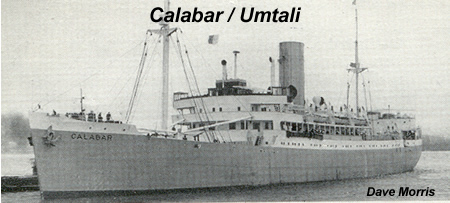
Allan and Eileen sailed from Liverpool on a Bullard Line ship called the “Umtali”,
arriving back in Sydney via Las Palmas, Durban and Perth. They then travelled
by train to Brisbane, then Gladstone.